

Key Takeaways
- The Core Goal: Shift from keyword optimization to entity authority building to get cited by AI search engines in 2026.
- The Strategy:
- Ensure NAP consistency across GBP, website, and all citations
- Build review velocity with consistent positive sentiment
- Implement LocalBusiness and Service schema markup
- Create hyperlocal topic clusters around your service area
- Earn verified citations from trusted local sources
- The Result: Become the verified answer for AI search in your local market and get cited in AI Overviews.
Complete Guide to AI Entity Signals Validation
If you’re still obsessing over keyword density in 2026, you’re playing a game that ended three years ago.
Today, AI search engines, Gemini, ChatGPT, and the new search layers, do not just look for words on a page. They look for entities. They want to know if you are a real, trustworthy business before they cite you in an AI Overview.
After 8 years of watching Google shift from strings to things, here are the 5 signals you need to nail if you want to be the chosen answer in your local market.
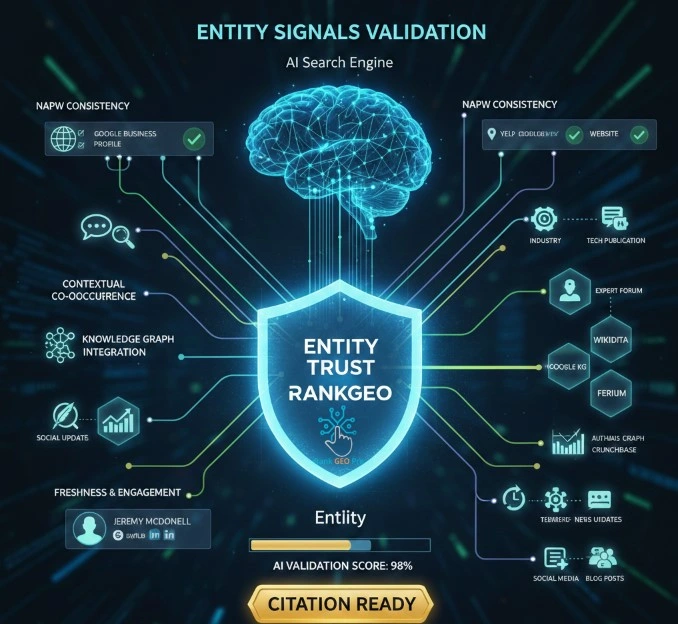
The 5 entity signals that determine whether AI engines trust and cite your local business in search results.
1. NAP Data Consistency (The ID Card)
Your Name, Address, and Phone number (NAP) are your digital fingerprints. If your Google Business Profile says “Suite 200” but your website says “Unit 2,” the AI gets confused. Confusion means no citation.
Pro Tip: Use
PostalAddressschema to match your GBP exactly.
2. Sentiment and Review Velocity
It is not just about a 5-star rating anymore. AI looks at velocity (how often are you getting reviews?) and sentiment (what specific problems are you solving?). If customers consistently mention your emergency response speed, you become the entity for that intent.
3. Structured Data (The AI Cheat Sheet)
Schema markup is how you talk directly to the AI system. By using LocalBusiness and Service schema, you provide a clean dataset that requires less guesswork.
4. Hyperlocal Topic Clusters
AI validates your location by checking whether you truly cover the area. Mentioning local landmarks, neighborhood-specific service issues, and community involvement creates a geographic entity that AI can trust.
5. Verified Citations and Third-Party Proof
If your brand is mentioned on trusted local organizations and news sites, you are no longer just a website, you are a validated entity.
FAQ: Winning the AI Shortlist
How does AI pick which local business to cite?
AI engines prioritize entity trust. They cross-reference your Google Business Profile, local reviews, and structured data to evaluate reliability for the user intent.
Does traditional backlinking still matter for GEO?
Yes, but context matters more. A link from a local, niche-relevant source often carries more entity weight than a generic high-DR mention.
What is the fastest way to improve entity signals?
Start with schema injection. LocalBusiness and FAQ schema help define your brand facts in a format AI systems can parse efficiently.
Check out our RankGeo pricing to see how we automate these entity signals for your brand.